


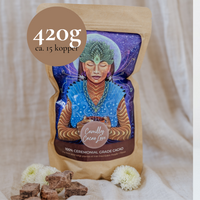







Article: Laboratory test of cacao: Your Camilles Cacao Love is wonderful nourishment
Laboratory test of cacao: Your Camilles Cacao Love is wonderful nourishment
According to Danish legislation regarding health claims, I may not write what these nutrients do for you physiologically or emotionally. But I recommend that you dive deeper into it on your own.
Since Camille's Cacao Love was tested in the laboratory – and I got some numbers on some of what the cacao contains
I have always shared cacao as a living, loving plant connection.
As a path to presence. An opening to the body. A friend in the silence.
But now something new has happened.
I have had my ceremonial cacao analyzed in an independent laboratory - Eurofins.
And even though I already know her power from within, it was a wild feeling to get some numbers on some of what the cacao actually contains.
Here I share some of the most important insights, so you can see with your own eyes what is hidden in this plant connection.
It feels as if nature itself has made a little nutrient package – wrapped in cacao beans.
1. The cacao contains magnesium
Magnesium is one of the minerals that is naturally found in cacao.
In the test, the cacao was shown to contain a significant amount of magnesium.
In fact, the levels are higher than in several common foods, including:
-
green leafy vegetables such as spinach and kale
-
bananas
-
almonds
-
avocado
It is quite fascinating to see how much is actually found naturally in the cacao bean mass.
2. Potassium and iron in the cacao
The cacao also contains potassium and iron.
The beautiful thing about the laboratory analysis is precisely that we can look at the cacao as the food it is, and get a concrete picture of its natural composition.
The cacao's iron content is comparable to, and in some cases higher than:
-
red meat
-
legumes
-
green vegetables
And its potassium content is above, for example:
-
potatoes
-
oranges
-
yogurt
-
many energy drinks and sports products
The numbers can naturally vary from raw material to raw material, but it gives an exciting insight into what is found in this particular cacao.
3. Zinc and copper – small, but interesting minerals
Zinc and copper are two of the minerals that are also naturally found in cacao.
And the cacao contains both of them.
It is interesting to see the overall mineral composition in a food that consists of a single ingredient: cacao bean mass.
4. Polyphenols – some of the cacao's natural plant substances
The test also showed a significant content of polyphenols – naturally occurring plant substances in cacao.
Cacao contains, among other things, various polyphenols, including gallic acid, catechin, and epicatechin.
When comparing different foods and beverages, the content of polyphenols can vary greatly depending on the raw material, variety, origin, processing, and measurement method.
The cacao's natural composition is therefore quite interesting to look at more closely in itself.
5. Theobromine and caffeine
Cacao also contains theobromine and a smaller amount of caffeine.
Theobromine is a naturally occurring substance in the cacao bean, and caffeine is also naturally found in cacao.
The caffeine content in cacao is relatively low compared to coffee, while theobromine occurs in larger amounts.
It is also one of the reasons why cacao and coffee are not completely the same, even though both contain naturally occurring stimulating plant substances.
6. A food with many natural components
Something of the most beautiful about cacao is that all these components are naturally found in the cacao bean mass.
Not as an added powder, extract, or a pill – but as a whole food.
When I look at the laboratory analysis, I therefore become even more curious about cacao as a raw material and about everything that is found in the little cacao bean.
For me, cacao is still about much more than numbers and values.
It is about the plant, the history, the people behind it, the soil it grows in, and the ritual we create around it.
7. When cacao is allowed to be both ritual and food
This blog post is not about reducing the cacao to numbers and values.
On the contrary.
I experience it as an honor to be able to hold both parts:
🌿 On the one hand – cacao as a plant ally, as a teacher, as a guide
🍫 On the other – cacao as a food with a completely special natural composition
One does not exclude the other.
It just strengthens my own fascination with this fantastic plant and everything it contains.
That cacao is a gift – both as food, plant, and as a part of our rituals.
🤎 Camille
Owner of Camille's Cacao Love since 2018

Written by Camille Ingvild


Leave a comment
This site is protected by hCaptcha and the hCaptcha Privacy Policy and Terms of Service apply.